Congratulations to MFS Past President, Phyllis Cole, Thoreau Society Medal Awardee

MFS Member Briggs Bailey (Left) stands next to MFS Past President Phyllis Cole (Right), wearing the Thoreau Society Medal at an MFS-sponsored dinner on July 11, 2023.

On July 11, 2024, at the 2024 Thoreau Society Annual Gathering, MFS Past President Phyllis Cole was awarded the Thoreau Society Medal, the society’s highest honor. MFS Second Vice President Christina Katopodis read a statement honoring Dr. Cole:

The Thoreau Society confers its highest honor, the Thoreau Society Medal, in recognition of “sustained, essential contributions to the legacy and vitality of Thoreauvian studies and ideals through extraordinary scholarship or service.” This year, we are delighted to extend this award to Dr. Phyllis Blum Cole.

Dr. Cole has had a distinguished career as a ground-breaking researcher, writer, editor, organizational leader, and professor. Her book, Mary Moody Emerson and the Origins of Transcendentalism: A Family History altered the landscape of Transcendentalism. In Bob Gross’s words, it is “a triumph of archival investigation” that “altered scholarship in several fields at once – Transcendentalism, New England’s religious and intellectual history, and women’s history.” Her discoveries in the archives reading Mary Moody’s “Almanacks” resulted in a book providing graceful translation of those works for a public audience and restored “Mary Moody Emerson “to the canon of the early republic.” Dr. Cole’s expert scholarship on women has shown us that, “In many ways Transcendentalism was a women’s world, both in the Thoreau household and in Concord and Boston” (Gross).

In awarding the Thoreau Society Medal to Dr. Cole, we celebrate not only the gifts she has brought us through her research and writing but also her trail-blazing leadership as a woman in academia. Her editorship, mentorship, and colleagueship—for example, her co-edited collection (with Jana Argersinger) Toward a Female Genealogy of Transcendentalism—has attracted the attention of early career women and gender nonconforming scholars, ringing a bell to announce that scholarship by women, and for women, and about women—including queer, trans, and nonbinary women—is not only welcomed but also essential to understanding Transcendentalism. Without Dr. Cole, I would not have seen a place for me here. It wasn’t until attending one of her panels at MLA in 2018, that I felt I had found my people, the people who make an academic life joyful and worth the struggle. Dr. Cole has served as President of the Ralph Waldo Emerson and Margaret Fuller Societies, as well as on the Board of Directors of the Thoreau Society, where she helped organize Annual Gatherings and guide the Society’s collections and fellowship awards. She has contributed to modernizing these important institutions through which we gather, learn, and commune.  

It is impossible to convey all the ways in which Dr. Cole is deserving of recognition and the many scholars and writers she has influenced, so I mention just a few. (And I’ve collected pages and pages more from your colleagues and friends who share a glittering of admiration, love, gratitude, and congratulations, that I will share with you after the gathering.) Megan Marshall writes of Phyllis’s [quote] “extraordinary skill and brilliance as a writer of scholarly prose . . . incomparable in her ability to write with both urgency and insight.” Noelle Baker emphasizes Dr. Cole’s influence as [quote] “a role model, a kind mentor and fierce advocate, a cherished friend, and invaluable colleague,” noting that her scholarship is [quote] “foundational to new feminist directions in several fields, including but not limited to transcendentalist studies, Emerson studies (now also populated by women, in large part inspired by her work), Margaret Fuller studies, Thoreau studies, and woman’s suffrage studies.” Finally, Jana Argersinger captures Dr. Cole’s openheartedness when she says, [quote] “Generosity is, for me, the shining through line in Phyllis’s way of walking through the world–generosity of heart and intellect for anyone who crosses her path.”

Dr. Cole, we thank you for your trail-blazing research and leadership, and your profound ability to build communities and connections that will sustain us for generations. You are both a pillar and a dear friend to the Thoreau Society, and we are honored to share this award with you.

MFS Members at dinner

Following the award ceremony, MFS members gathered for dinner at Fiorella’s Cucina held in honor of Dr. Cole.

“Conditions of Exile in the Nineteenth-Century and Beyond” at MLA 2023 (Event Recap)

In early January 2023, we gathered in San Francisco for the MLA convention where the Margaret Fuller Society sponsored a panel on Conditions of Exile in the Nineteenth-Century and Beyond. (Read the original call for papers here.)

Dr. Christina Katopodis presided the panel, which included papers by Marlas Yvonne Whitley, who is a graduate student at North Carolina State University; Sabrina Evans is an ABD PhD candidate in the English and African American and Diaspora Studies Dual-Title Program at Penn State University; Thomas W. Howard, who is a Ph.D. candidate in English and American Literature at Washington University in St. Louis; and Dr. Stephanie Peebles Tavera, who is Assistant Professor of English at Texas A&M University–Central Texas.

In her presentation on “Trying to Transcend: Black Escape and Transnation from The Colored Conventions to the Harlem Renaissance,” Whitley worked toward a rhetorical and aesthetic genealogy of Black transcendence of racism and white supremacy, and what it means to theorize such a concept as we continue necessary conversations on racism and anti-Blackness in the U.S. (Read the full paper abstract here.)

Evans, focusing primarily on Mary Church Terrell and Ida B. Wells in “Exile and the Perils of Travel: The Challenges Behind Nineteenth-Century Black Women Organizers’ Fight for Dignity,” argued that in exploring the tensions between their public activism, the perils of travel, and exile within their published and private writings, Black women organizers challenged and redefined what dignity meant for Black women. (Read the full abstract here.)

In “Du Bois in Berlin, Du Bois in Atlanta: The Affect of Exile in The Souls of Black Folk,” Howard examined Du Bois’s later writings and influences from Germany and Ghana, showing that Du Bois does not simply reveal international influences, but rather he writes from within the tradition of the
German aphorism (Aphorismus), especially within his passage on “double-consciousness.” His
unique vision as an African American returning from Germany thus allows him to see how
African spiritual traditions co-create “American culture” alongside the white “other world.” (Read the full abstract here.)

Dr. Tavera in “Exile’s Persistence: Margaret Fuller and the Public Trauma Culture of Expat Paris” located the evolution of a public trauma culture in the traditions of women’s travel writings, especially those of Margaret Fuller who served as a foreign correspondent and hospital volunteer during the Risorgimento (circa 1847-49). Dr. Tavera showed that just as Fuller re-formed American audiences’ perceptions of Italy from an arcadian landscape to a site of Republican values using wartime trauma as an opportunity for grieving, women writers of high modernism re-formed audiences’ perceptions of Paris as the site of a decade-long soiree where anything goes in the wake of a grieving postwar generation. Women writers of high modernism capitalized on the transatlantic tradition of turning grief into grievance against a culture that refused to reconcile with difference. (Read the full abstract here.)

The papers encouraged us to see the self-determination and individualism in American Transcendentalism(s) as reliant on collectivity, collaboration, and friendship, being in conversation. Discussion included parallels drawn between the AME church and Unitarian communities; exile as relief and as a self-constructed place or self-determined location; the environment as an internal reality (James Baldwin); William Jamesian stream of consciousness as a movement between individual thought to collective thinking and back; and tenderness with ourselves and with others in public trauma narratives.

Event Recap: Fuller Society Panel at the July 2022 Thoreau Gathering

This post was written by Contributing Author and MFS Past President Phyllis Cole.

The Margaret Fuller Society contributed a panel with the title “Where in the World is Margaret Fuller?” to the Annual Gathering of the Henry David Thoreau Society in Concord, Massachusetts on Thursday, July 7, 2022. For several years we have been broadening the Annual Gathering’s previously exclusive focus on Thoreau by offering, along with the Emerson and Alcott Societies, an array of presentations on Transcendentalist and Concord-based authors. Always we have contributed to the Thoreauvian theme of the year, which this year was “Globalism.” What better perspective than this on Fuller, whose reading, life travels, and influence were always international? We might truly ask “where in the world” we want to locate her.

It has been my pleasure as a member of the Thoreau Society Board of Directors to plan this dimension of the Gathering program and to moderate the 2022 Fuller panel. I was particularly delighted that the papers proposed found such different angles on the broad topic. We had Fuller reading female-inflected German Romanticism in one paper, negotiating the difficulties of trans-Atlantic letter-writing in a second, sustaining friendship with an Italian noblewoman of opposing political belief in a third, and finally making her belated appearance in today’s China. At the same time some common themes emerged in these papers: epistolary expression, friendship between women, translation as vital work from Fuller’s day to our own. The members of our panel themselves range in background across national boundaries. You can read their full paper abstracts and bios here.

Alice de Galzain, doctoral candidate at the University of Edinburgh, began the session with her paper “Woman [and] Artist”: Margaret Fuller on Bettine Brentano-von Arnim and Friendship.”  Fuller taught herself German, then used it to read Bettine’s epistolary novel, translate the text into English, and interpret its meaning to Dial readers. De Galzain claims these cross-lingual acts as “feminist agency,” especially as they contribute to Fuller’s celebration of gender-defining women’s friendship, proceeding from within the soul and extending outward.

Cheryl Weaver, doctoral candidate at the University at Buffalo, approached epistolary expression in terms of problematic conveyance as well as content, in “I found your note here several days since”: Margaret Fuller and Postal Delivery from Europe. Fuller’s 1846 voyage to Europe came in the midst of American developments of both the postage stamp and the penny post, so that access to letter exchange boomed. But mail across the Atlantic was both more expensive and more problematic, as Fuller reveals in her private letters over the two years following.

Letters and their reports of conversation serve as evidence in Mario Bannoni’s paper, The Opposing Political Passions and Common Womanly Positions of Margaret Fuller and Costanza Arconati Visconti on the Eve of the Italian Risorgimento. Communication between Fuller and Arconati was a linguistic challenge: at first neither spoke the other’s language with confidence, so that they wrote to each other in French. And this was only the beginning of their difference, which also encompassed social status, religion, and position on the needed transformation of Italy. Nonetheless the two mutually defined a friendship ascending from inward soul to womanly bonding.

Close correspondence and friendship between Fuller and China never took place, but Julia Xianju Du explores cultural contact then and now in Margaret Fuller in China. Despite the Chinatown growing up in Boston (not far from the Peabody Bookstore), her contact with Chinese culture was limited to reading and quoting of Confucius. Even this, however, shows the power of translation as a trans-global resource of her time. In twenty-first century China there is growing interest in Fuller’s place among American Transcendentalists and advocates of women’s rights, with master’s theses about her on the rise. But translation of her actual writings is work still needed.

Read the full abstracts for the presentations here.

Event Recap: MLA 2022

This post was written by contributing author Dr. Christina Katopodis, who also presided on the panel.

On Sunday, January 9, 2022, the Margaret Fuller Society’s Ad Hoc Committee on Racial Justice hosted a virtual session at MLA 2022 on “Mattering in the Nineteenth Century and Beyond: Transcendentalisms, Racism, and Repair in the United States.” It was such a pleasure to moderate this round table discussion and to listen to exciting and even groundbreaking scholarship in the field. Read the paper abstracts and full bios for the panelists here.

Delivering a paper on “Transcendentalists and the Black Atlantic,” Dr. Katie Simon started us off with her discussion of Ralph Waldo Emerson and whiteness studies. Dr. Simon focused especially on how Gilroy’s work on the Black Atlantic shakes up geographical stuckness in New England, pointing to the mass genocide of the transatlantic slave trade fueling national and global commerce, and goods sold in the “free” states made and grown by enslaved people.

Doctoral candidate Jessica Elkaim addressed Walt Whitman’s unreconciled racism, his problematic blindness to bodily difference and the corpsification of bodies in his writings in her presentation on “Whitman and the Republic of the Dead,” developed from a chapter in her dissertation at the University of Toronto in which she analyzes representations of corpses in nineteenth-century American writings. 

Next, Andrea Walton of Illinois Central College traced the long genealogy of the Mammy stereotype from black face minstrelsy, Billy Kersand’s “Old Aunt Jemima,” Drysdale’s “Old Chloe” in Scenes in Georgia (1827) and more, to transvestite Mammy and asexual Mammy stereotypes. Her presentation on “Aunt Jemima: A Mascot for African American Femininity” tied this racist history to white complacency and tolerance and the systemic racism embedded in corporate America which continues to capitalize on racist stereotypes to sell products like pancake syrup.

Dr. Ben Bascom in “Empire of Smell: Douglass, Thoreau, and Queer Fungibility” called to our senses the smell of the Fitchburg railroad and the body of the author — Henry David Thoreau — who recalls readers to their own bodies through olfactory description. Dr. Bascom reminds us that when we smell we are taken over by otherness — the nose is an aperture that doesn’t close, much like the ears. His attention to the body reminded us of the humanity of these historical authors as well as how smell was racialized in the nineteenth century.

In “Miss Peabody’s Racism,” Dr. Mark Gallagher underlined the point that nineteenth-century antislavery efforts were not equivalent to actually calling for racial equality; in fact, some antislavery writings reinforced white superiority. His presentation illuminated the white supremacy embedded in Elizabeth Peabody’s writings (she was, like Ralph Waldo Emerson, late to abolitionism), particularly in her conception of the spiritual body. Dr. Gallagher argued that Transcendentalism can reinforce racism by not acknowledging the spiritual nature of nonwhite bodies.

PhD candidate Jacob Walters concluded the panel with his presentation on “Dark Vistas: Circles, Sketches, and The Penumbra of the Future in the Thought of W.E.B. Du Bois.” In his discussion of Du Bois’s megascope, his talk brought to center stage the “constellation of tensions” in the lives of all the authors and figures discussed in the session. In thinking of Du Bois’s double consciousness, unknowing, reorienting one’s viewing, and trying to find humanist universality through the fragments and glimpses of real lives, we all were reminded of the humanity of these authors, their uncertainties, their sometimes contradictory traits juxtaposed, and how they recall us to our own humanity as scholars and people in the world.

These authors were not perfect. They had bodies that smelled, opinions that changed, some ideas worth keeping and others worth critically reevaluating and problematizing. If we’re willing to treat them as complex and changing, they can help us to reflect on our common struggles, fight for equality, and resistance to injustice today.

Honoring Christina Asquith with MFS Award for Social Service

A Message from MFS Past President Phyllis Cole:

It’s a great pleasure to let Fuller Society members know that on July 9 we presented our triennial Award for Social Service to pioneering journalist and educator Christina Asquith.  The setting was our society dinner party at the American Literature Association meeting, with thirteen of us, including Christina and her ten-year-old daughter Marianna, gathered around a conversational table at Piattini in Boston’s Back Bay. 

The Social Service Award recognizes ”extraordinary achievement in extending the social ideals advanced by Margaret Fuller,” and the award committee realized immediately that this year’s honoree had to be Christina Asquith.  You may remember that in 2018 Megan Marshall offered an interview with Christina in Conversations, which you could access here.  But now we have caught up with her more recent career as well.   

Through the interview we heard about Christina’s amazing work in establishing the Fuller Project for International Reporting, designed to support the investigation of women’s issues around the world.  Christina had personally experienced the difficulty of getting such issues recognized by major press outlets as a freelance reporter in Baghdad and Istanbul in the years after 2003.  A decade later, reading Megan Marshall’s biography of Fuller as she organized this collaborative project was like ”gasoline poured on a simmering fire,” she said, and as a result the project honored Fuller in its official name.    Christina Asquith served as editor-in-chief of the Fuller Project from 2014 to 2020, during which time the organization raised $5 million for its work—with more in the pipeline—and grew incrementally in scale and visibility.  Some of their early stories concerned a Syrian girl who lost her violin and music career in the war, a tragically large number of Russian women murdered through domestic violence, and a Turkish woman with an MBA inheriting her father’s confectionary business.  But Christina also landed a cover story in Time magazine (9-2-2019) about women living less far away, in the “Left Behind Economy” of waitress work for minimum wages in this country.  By 2020 the Fuller Project had become an established part of the international press, and you can see its range of current publications here.   

At this point, however, Christina was ready for a new initiative.  The burgeoning of the Fuller Project, she felt, owed a lot not just to its unfolding in times of #MeToo, Mideast war, and Hillary’s well-publicized campaign.  In addition, a new generation of women around the world was getting educated to use Twitter and the internet and do their own coding.  And so she took on direction of the new Hack Club, an educational initiative to accelerate such literacy, through an alliance of school-based clubs around the world with the most advanced women in tech spaces, from bitcoin to artificial intelligence and space technology.  “I wanted to be part of something radical,” she wrote to me about this in one email.  We live in an internet-driven world; collectively we create a new kind of journalism, with many people rising with skill to tell their own stories. And yes, she assured me, this social justice campaign was equally in the spirit of Margaret Fuller.  Our committee agreed right away!   “Learning to code,” declares the club’s website, “is uniquely like gaining a superpower—turning you from a consumer of technology into a creator.”  

And so the Social Service award recognizes Christina Asquith as both a journalist and an educator.  At the dinner in Boston she was given a carved wooden plaque, as well as a modest donation to the Hack Club and lifetime membership in the Margaret Fuller Society.  To Marianna we gave a book sack with the motto “Let them be sea captains,” courtesy of the website for Peter Reilly’s Fuller documentary.  Christina warmly embraces her membership and hopes to stay in touch as we move forward toward an international conference on “Journaling for Justice.”   

Three years ago the Social Service award was given to me (indeed given my name), recognizing work simply to further the society’s connection with the Margaret Fuller Neighborhood House in Cambridge.  As I hope you know, this was her birth home, not far from Central Square; but since the early twentieth century it has also been a service center for the working, often immigrant and economically struggling, people in its area. I’ve been happy to increase the contact between this place and Fuller’s legacy, including her own calls for justice to the poor. But this year, heading the search for the next recipient of the “Phyllis Cole Award for Social Service,” I have welcomed the opportunity to flip the picture and recognize communications about women around the world. Both are authentic Fuller. Writing to the Tribune from Rome in 1848, she described violence against women in the very midst of revolution as a subject she would take up again “if I live.” Instead, she had to rely on the efforts of others, among whom we’re happy to recognize Christina Asquith and her expanding network. 

Please join me in welcoming Christina to the Margaret Fuller Society. 

Phyllis 

Past President, Margaret Fuller Society 

Growing a Beauteous Art Exhibit

This post was written by Contributing Author Jenessa Kenway, a doctoral student at University of Nevada Las Vegas. Her dissertation work explores links between pastoral and botanical imagery and the expression of feminine consciousness.

I was deeply inspired by a 2018 conference organized by the Society for the Study of American Women Writers (SSAWW). The conference showcased a dazzling array of feminine scholarship and women authors of every rank and file and it was my first time presenting a paper at a conference. SSAWW scholars introduced me to a new realm of the academic world and the interconnected nature of that world. I left with a hurricane of ideas, and two lasting things: friends in the Margaret Fuller Society and the idea for an art exhibit.

I was already interested in Fuller and the visual arts. The essay I presented, “The Visual Genealogy of Margaret Fuller,” explored Fuller’s feminine aesthetics and potential interest in women artists. I owe many thanks to the supportive Fullerites on the panel and in the audience whose friendly presence and support helped calm my nerves.

The Seeds

After my panel, I attended loads of others, one of which­–a roundtable on Louisa May Alcott and the humanities­–stood out from the rest. The presenters all covered innovative strategies for teaching Alcott that were applicable to literature in general. Last to present was Mark Gallagher, who overviewed the exhibition he put together for the UCLA Library for the 150th anniversary of Little Women. His exhibit displayed artifacts from Alcott’s life and showed Alcott’s continuing influence by featuring the work of women writers and leaders who were inspired by the rebellious protagonists of Little Women.

An art exhibit about literature: I was hooked. At the Friday night mixer, Gallagher generously shared with me more about his exhibit, and I began to plan my own.

My background is in visual art. In a former life, I pursued a career as a visual artist, that is until I discovered that I loved writing about art. I’ve come to realize that writing is as much an art form as the plastic arts. While they have their distinctive qualities, text and image share much in common and complement one another.

A literary art exhibit seemed to be the perfect way to merge my past with my present, the world of art with the world of literature. Soon Fuller’s visionary essay, “The Magnolia of Lake Pontchartrain,” became the narrative inspiration for my own exhibit: A Beauteous Tree: Margaret Fuller’s “Femality,” which was open at the Marjorie Barrick Art Museum from May 28 to July 24, 2021. You can take an informal tour of the exhibit here (opens in new window).

I envisioned a hybrid exhibit: text and images nested within a space that is itself a work of art. In the exhibit, a thick green band, like a green scroll or long segments of chalkboard, circumnavigates the entire display space, elevating quotations to the level of paintings. Strategically placed magnolia leaf accents create viewing areas further uniting text and image pairings.

The Roots

The Magnolia tree of Fuller’s story explores the roots of feminine creativity through one of the oldest flowering trees on the planet. The use of a tree offers a means of expressing feminine identity while avoiding the gender indicators of the human body. The idea that feminine expression could occur without a female body, opens the story—and Fuller’s concept of “femality”–to a host of modern gender readings, of which she had never even dreamt, but nevertheless, renews the relevance of her work in our scholarly climate of diversity. This led me to organize the show around the magnolia story and Fuller’s concept of “femality.”

Like Gallagher’s exhibit, I was committed to showing how the literature of the past carries forward, impacting our lives today. I focused on tracking the appearance of Fuller’s concept of “femality” in other feminist texts and then paired these literary manifestations with works of visual art that enhanced the concept, providing a focal point for theory and story.

Thinking about how literature impacts us now makes me think about the different audiences of literature, from casual readers to university students to academic scholars. The format of an art exhibit was a good way to reach those different audiences and bring together different types of readers and find common interests. I think as scholars we don’t want to just be writing and making things for each other. It is important that the work of academia is accessible and has relevance and value to people outside of institutions.

The Fruits

In the wonderful zoom talk that she gave in conjunction with the exhibit, Dr. Christina Katopodis highlighted the benefits of biodiversity and the social and environmental dangers of allowing monocultures to dominate. People, plants, and insects thrive upon biodiversity that encourages, as Katopodis said, “diverse and vibrant” beings. At the 2018 SSAWW conference, within the Margaret Fuller Society, and in the organization of this exhibit, I experienced this vibrant diversity.

Activities during the zoom lecture demonstrated the diversity Katopodis talked about. She gave us three minutes and we each drew a magnolia flower that resulted in a host of floral interpretations that said as much about the one drawing as the flower they were thinking about. Later, we read passages from Fuller’s letters which included brief descriptions of plants such as amaranths, violets, and rose bushes. With each quote, we attempted to express the feelings and visuals of the plant imagery through the positioning of our hands and arms. In each exercise, we creatively expressed our observations. Watch the full lecture here (opens in new window).

For the exhibit, I held a drawing workshop on a Saturday afternoon, in which I talked about Fuller’s magnolia story, my own self-identification with the willow tree, and asked people to think about what they would look like as a tree. After a little hesitation, everyone began drawing. There was a tree with a fluffy bursting top; a long sinuous limbed tree of the savannah; a tree with ceremonial terracotta figures growing upon it, trees with hearts, lines of small trees representing children in front of big parental trees; trees blown by gusting winds.  Each tree was different, and everyone was able to find their own tree self.

The SSAWW conference is, of course, unrivaled feminine diversity. And the smaller circles of SSAWW also demonstrate diversity and interconnection. At a special luncheon, there were tables occupied with an assortment of nineteenth-century literature societies including Catharine Maria Sedgwick, Louisa May Alcott, Margaret Fuller, and Harriet Beecher Stowe, many of whom also have ties with the Emerson and Thoreau societies. While I’m not a member of all of these groups, I am connected through the cross-sharing of CFPs and the general spirit of cooperation. Talking to one another and allowing members to mingle, encourages rich conversation and an interconnected scholarly community.

My initial hazy goal of putting together an art exhibit inspired by Fuller taught me about myself and the kind of scholar I want to be and the positive effect of sharing ideas. The ideas and people I met through today’s vibrant network of scholarship grew into a beautiful art exhibit.

Jenessa Kenway is a Ph.D. candidate in literature at the University of Nevada Las Vegas studying feminine aesthetics and interconnections between art and literature from the 19th century to present. Her essay “Talking with a Magnolia Tree: Margaret Fuller and American Transcendentalism” was published in the 2019 Norton UNLV world literature essay collection, Sing Goddess. Her work tracking beauty and the sublime in Elizabeth Stoddard’s Two Men won the 2020 Brooks-Hudgins award and she was awarded the Dorothy Mae Freischel scholarship for excellence in interdisciplinary scholarship, projects, and classroom instruction methods. Her essay on visual and literary superrealism in the work of Karl Ove Knausgaard was published in 2019 in Penn State’s interdisciplinary journal Soundings. She writes on art and culture for KNPR’s Desert Companion and teaches courses in composition and world literature.Support for the exhibition came from the UNLV Jean Nidetch CARE Center, a Nevada Humanities Project Grant, The National Endowment for the Humanities, and the WESTAF Regional Arts Resilience Fund, a relief grant developed in partnership with The Andrew W. Mellon Foundation to support arts organizations in the 13-state western region during the COVID-19 pandemic.

19th-Century Women Writers and Archives

Image is an original illustration of the panelists by Jojo Karlin.

At the remote 2021 MLA Annual Convention, and the Margaret Fuller Society is hosted a roundtable on “19th-Century Women Writers and Archives,” presided by Margaret Fuller Society President Sonia Di Loreto. The panel fulfilled its promise to showcase the ongoing work of several scholars undertaking archival research to tell the stories of lesser known women writers and women musicians as well as the exciting digitization projects of several scholars working to publish women’s writing for the general public online.

Women mentioned included Julia Ward Howe, Lydia Maria Child, Edna Dow Cheney, Maria Zakrzewska, Susan Dimock, Caroline Healy Dall, Jane Austen, Mary Elizabeth Lucy, Margaret Fuller, Caroline Sturgis Tappan, and Catharine Maria Sedgwick, among others.

Click on the links below to read the full paper abstracts.

“The Margaret Fuller Society Archive,” Charlene Avallone, Margaret Fuller Society Immediate Past President, Independent Scholar [abstract]

“Digitizing Nineteenth-Century Women’s Writing Using Manifold,” Christina Katopodis, Margaret Fuller Society Advisory Board and Website Manager, The Graduate Center, CUNY [abstract]

“What Nineteenth-Century Women’s Music Collections Can Show Us,” Elizabeth Weybright, The Graduate Center, CUNY [abstract]

“Arcadia in the Archives: The Utopian Imagination of Margaret Fuller’s Conversationalists,” Ariel Silver, Columbus Ohio Institute of Religion [abstract]

“Transcendental Women Losing Their Religion,” David Faflik, University of Rhode Island [abstract]

“Persistence: From the Archives to the Digital Edition–Catharine Maria Sedgwick Online Letters Project,” Lucinda Damon-Bach and Alyssa Carrizales, Salem State University

Margaret Fuller at MLA 2020 in Seattle

On Saturday, January 11, 2020, we gathered at the MLA Convention in Seattle, WA, for a panel on “Margaret Fuller’s Ecologies,” presided by Margaret Fuller Society Vice President, Jana L. Argersinger. Below is the list of presenters and their paper titles.

“The Ecological Spirituality of Margaret Fuller’s Summer on the Lakes”
Lucas Nossaman, U of Tennessee, Knoxville

“Traveling West through Womanhood: Indigenous Women and the Landscape of Developmental Time in Fuller’s Summer on the Lakes”
E S Dean, Rutgers U, New Brunswick

“From Genial to Daemonic: Margaret Fuller’s Early Theories of Relationality”
William Bond, Northeastern U

Abstracts are available here.


Margaret Fuller at ASLE 2019

This post was authored by Guest Contributor and Margaret Fuller Society Member Nanette Hilton.

The 2019 Association for the Study of Literature and the Environment (ASLE) Conference uncannily presaged the November 2018 Camp Fire which destroyed the town of Paradise, California. The unsettling “resonance” between the conference theme, “Paradise On Fire,” and the affected California host communities prompted planners to issue an October 31, 2018 explanation that “the title was intended to be metaphorical” and drew “from the long literary imagining of California as another world” (ASLE).

June 26th through 30th, 2019 conference attendees came together to mourn “the loss of life, home and habitat in that fire” as a group “dedicated to grappling with difficult, long-term and often irresolvable issues,” not just in present-day California but since the Anthropocene’s impact on the global environment. Such exigencies were familiar to Margaret Fuller who likewise struggled to make sense of challenging concerns.

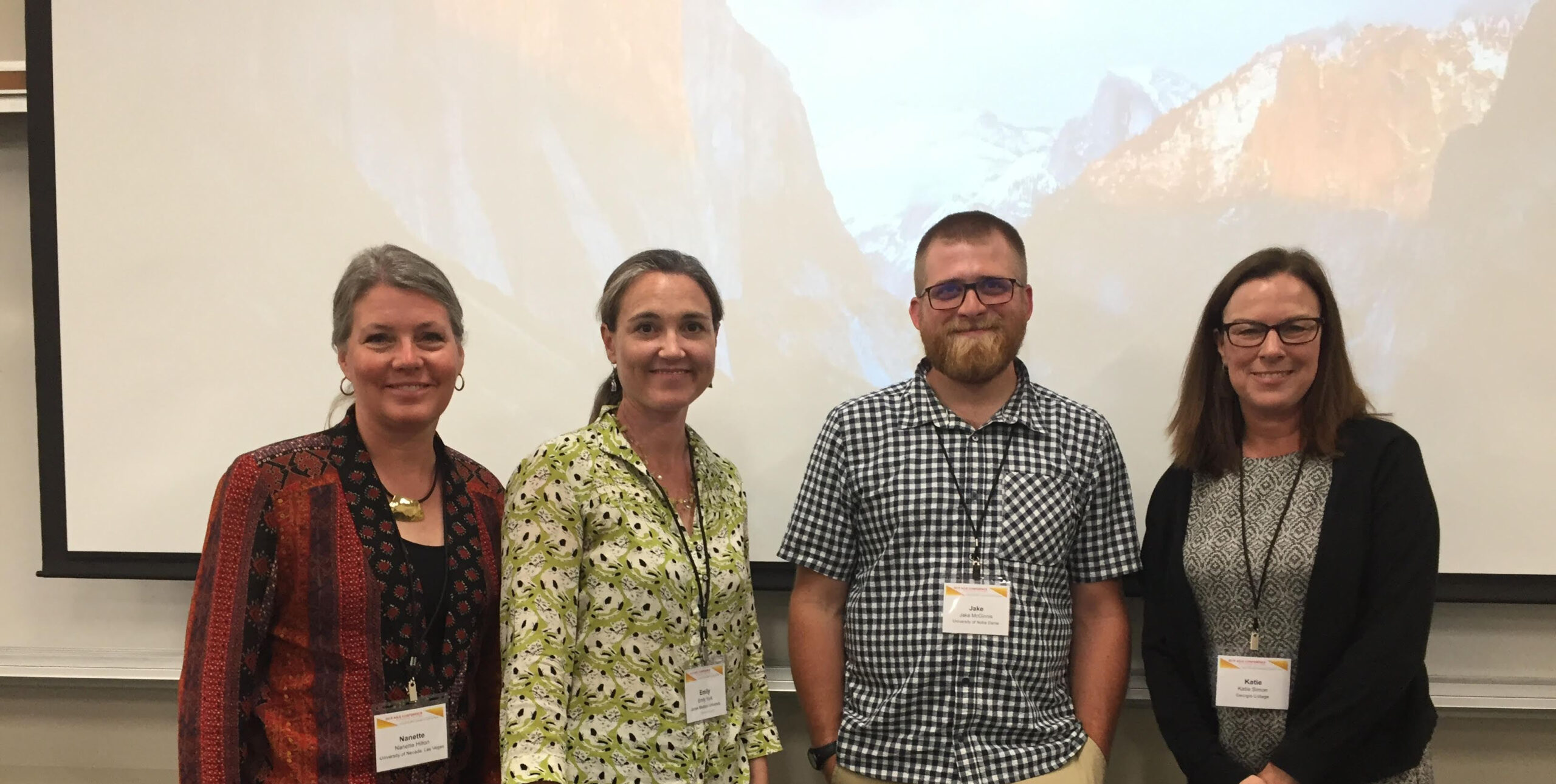
For this reason, Nanette Hilton organized an ASLE panel entitled “Margaret Fuller: Preserving Paradise in the 19th Century” in which she asked how Fuller champions, appropriates, and interacts with ecology in her texts? To what end, then and now? In what ways might Fuller’s personal struggles, or the struggles of those she represents in her texts, mirror socio-ecological struggles, past and present? Is Fuller’s a universal or microcosmic ecological awareness? How does Fuller resist or cross metaphorical or literal boundaries and in what ways might this impact Earth’s environment? The panel explored how Fuller was on the vanguard of form and genre hybridization and how she championed inclusivity long before it was politically correct. The panel hoped to mine the ecocriticism of Fuller’s heterogeneous works for models of rhetorical strategy as patterns for us, nearly two centuries later, in our efforts to preserve Paradise.

The response to this call for papers gave heartening evidence that Margaret Fuller is taking a front seat in literary studies, even in environmental humanities. Ultimately, four papers were chosen to be presented, including:

  • “The Book to the Reader”: Affect and Bioregion in Summer on the Lakes, by Jake McGinnis of University of Notre Dame;
  • Amalgamation of Sensibilities: Margaret Fuller Prophesying Paradise, by Nanette Hilton of University of Nevada, Las Vegas;
  • Ecology, Difference, and Boundary-Crossing, by Emily York of James Madison University; and
  • Troubling Paradise: Racialized Violence in Margaret Fuller’s Summer on the Lakes, by Katie Simon of Georgia College.

By coincidence, all four panelists centered their papers on Fuller’s Summer on the Lakes (Summer) to create a serendipitously cohesive analysis of her text.

Jake McGinnis observed how Fuller’s personal anxieties were juxtaposed with “the environmental, social, and gender crises that shaped the frontier of 1843” and provide a “crucially important model for our own processes of working through the growing problems of American regionality—from the urban/rural political divide to brain drain and pervasive gender inequality.”

Nanette Hilton focused on Fuller’s rhetorical choices in creating a mash-up of genres thereby foregrounding what feminist theorists today term Invitational Rhetoric which advances “equality, immanent value, and self-determination” amongst actors, human and nonhuman. Hilton explicated the first two poems in Summer, providing proof that Fuller invites her readers to participate in preserving Paradise.

Emily York provided an auto-ethnographic account of her re-engagement with Fuller’s work nearly twenty years after writing her BA thesis on Fuller. She explained her “current efforts to reflexively reconsider Science and Technology Studies” with the aim to cross “boundaries of discipline and genre” to “build solidarity toward a socially and ecologically inclusive future.”

Katie Simon discussed how Fuller “encounters a landscape haunted with racialized violence” and through her “hybrid forms and textual assemblages” created a model for us to “engage with both nonhuman nature, and humans who have been ghosted from the category of the human” to “appreciate its sublime effects.”

The session enjoyed an audience of about twenty people. After the session, the panelists and their guests got better acquainted and continued their conversation over a marvelous dinner at Seasons restaurant.

In keeping with the prescient nature of ASLE’s conference theme, it was unanimously agreed that Fuller foreshadowed in Summer rhetorical strategies for confronting the ecojustice challenges we face today and prophesied a future wherein all actors have a voice in preserving Paradise.

______________________________________________________________________________

Works Cited:

ASLE. asle.org/stay-informed/asle-news/2019-conference-call-papers/

American Literature Association (ALA) 2019 Conference Recap

This post was co-authored by Charlene Avallone, Elizabeth Dean, and Christina Katopodis. Photos courtesy of Noelle Baker, and paper abstracts provided by Sonia Di Loreto.

On Thursday, May 23rd, Margaret Fuller Society (MFS) members gathered at the American Literature Association conference in Boston. MFS President Charlene Avallone and MFS Treasurer Noelle Baker delivered papers on the “Recovering the 19th-Century Women’s Rights Movement” panel moderated by Jen McDaneld. Avallone discussed “Laura C. Bullard, Harriet Beecher Stowe, and George Sand in the Nineteenth-Century American Woman’s Movement,” and Baker presented “Elizabeth Cady Stanton and Women’s Reproductive Rights.” A vibrant discussion followed focusing especially on women’s reproductive rights then and now. MFS Website Editor Christina Katopodis presented her fold/unfold pedagogical exercise in “Unfolding Fanny Fern’s Ruth Hall and Nathaniel Hawthorne’s ‘The Birthmark’” on the Hawthorne Society panel. Following the day’s panels, there was a welcome reception in Essex South and a roundtable on “The Old Corner Bookstore; or Why is the Most Important Literary Site in Boston a Fast-Food Court?”

For a more comprehensive list of MFS members who presented on panels and roundtables at ALA, see the list at the end of this post.

On Friday, Mollie Barnes of University of South Carolina Beaufort gave an engaging paper on the panel “Anonymity, Access, Absence: Challenges of Recovering Nineteenth-Century Literature,” titled “Transatlantic Recovery: How Margaret Fuller’s Lost History Teaches Us to Read,” which moved away from Fuller’s own texts to examine the development of Fuller’s mythos and legacy through periodical reports of her death.

IMG_1420
From the session “Winged Sphinxes: MF’s Poetry and Poetics,” left to right: Ariel Silver (MFS member), Joan Wry (former MFS Board), Katie Simon, Thomas Sorensen, and Katie Kornacki (MFS newsletter editor)

The Saturday, May 25th session of the ALA conference featured well-attended back-to-back panels sponsored by the MFS. First Vice President Sonia Di Loreto chaired the first panel sponsored by the MFS, “Margaret Fuller’s Languages.” The papers focused primarily on Fuller’s prolific translation work and the ways these translations fit into her overarching intellectual projects. Board Member Fritz Fleishman presented on “Translating Fuller: The Play of Interpretation.” Brigitte Bailey of University of New Hampshire gave her paper, “Translating Urban Radicalism for the New-York Tribune: Fuller’s Readings of the Deutsche Schnell post,” which connected directly with the attention to Fuller’s interest in German language and philosophy as covered in the paper given by Christina Zwarg (Haverford College), “Glimpsing Goethe’s Corpse: Translating the Now in Fuller’s Eckermann. Chaired by Katie Kornacki, editor of “Conversations,” the panel he second panel also approached Fuller from a formal/generic angle, focusing particularly on her poetry, and was titled “Winged Sphinxes: Margaret Fuller’s Poetry and Poetics.”  The papers were “Fuller and the Flowering a Female God: Male Sacrifice and Female Transfiguration in ‘Raphael’s Deposition from the Cross’’” from Ariel Silver of Claremont Graduate University, “Portals of Transformation: Object Studies in Fuller’s 1844 Poems” by Joan Wry of Saint Michael’s College, “The Vanishing Indian in Margaret Fuller’s ‘Governor Everett Receiving the Indian Chiefs, 1837’” by Thomas Sorensen of University of Western Ontario, and “Fuller’s Hauntological Poetics” by Katie Simon of Georgia College. This panel was followed by a particularly lively conversation regarding the potential intersections of thing theory and Margaret Fuller’s poetry, particularly growing out of Silver’s and Wry’s papers. Read the full abstracts and panel CFPs here.

These two excellent panels were followed by the Margaret Fuller Society’s businesses meeting, for which full notes are available here.

IMG_1430
Phyllis Cole (left), Past President of MFS, and Noelle Baker (right), MFS Treasurer

On Sunday morning a dozen Fullerites–Society members and guests–ended the conference by sharing brunch at Brownstone’s, billed as “a star on Boston’s vibrant culinary scene.”  Thanks to the planning of VP1 Jana Argersinger, we enjoyed good conversation over eggs Benedict and granola. Talk of Fuller ranged over the past and future, as guests included Peter Wiley, whose ancestor John Wiley published (and censored) the author, and members discussed plans and dreams for the next international conference the Society will sponsor, to be co-ordinated by Mollie Barnes. 

IMG_1425
Margaret Fuller Society members at Sunday brunch

Many society members participated in panels and roundtables at the conference, including:

Noelle A. Baker and Sarah Connell (Women Writers Project, Northeastern University), “Mary Moody Emerson’s Almanacks and Women Writers Online: A Casebook on Collaboration”
Mollie Barnes, participant in “Round Table on Today’s Academic Job Market: Strategies and Considerations”
Phyllis Cole, participant in “The Emerson Society at 30: A Roundtable Discussion”
Lucinda Damon-Bach, “Mining Letters for Fictional Purposes”
Elizabeth Dean, “Queer(ed) Kinship and the Sketch: A Genealogy of Political Care in Child and Alcott”
Helen Deese, “The Emerson Society at 30: A Roundtable Discussion”
Len Gougeon, “The Emerson Society at 30: A Roundtable Discussion”
Daniel S. Malachuk, “Settler Colonial Studies and O Pioneers!“
Joel Myerson, “The Emerson Society at 30: A Roundtable Discussion”
Sandra Harbert Petrulionis, “’Emerson Seems to Have Arrived’: The Reform Network of Mary Merrick Brooks”
Audrey Raden, “Stowe, Thoreau, and the Vanishing New England Forests”
David Robinson, “The Emerson Society at 30: A Roundtable Discussion”
Ariel Silver, “Stowe and Stanton in Conversation over the Religious Representation of the Female”
Lisa West, “Gothic, Supernatural, or Enchanted Flights in Sedgwick’s Novels”